Foundational Themes & Intellectual Framework (1956)
Documented foundational themes examined in the Kanpur 1956 engagement associated with Jagadguruttam Shri Kripalu Ji Maharaj.
Akhil Bharatvarshiya Bhakti Yoga Darshanic Mandal
Kanpur — 5 October to 19 October 1956
This appendix records the principal themes formally circulated to invited scholars and saints prior to the 1956 Kanpur Convention.
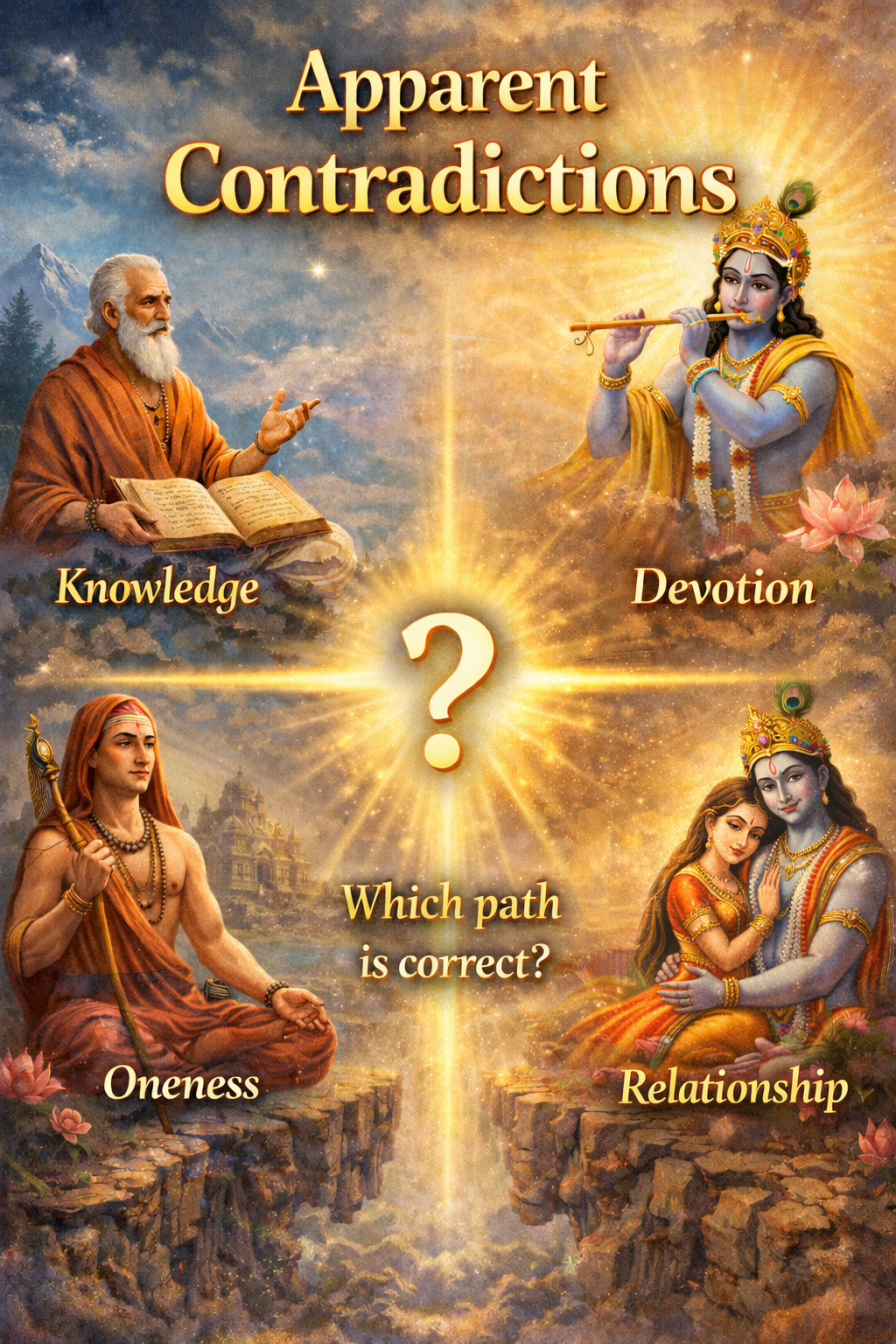
Unlike the 1955 Chitrakoot assembly — which centered on reconciling philosophical contradictions within scriptural traditions — the Kanpur Convention expanded the inquiry into the relationship between spiritual truth and lived human life.
The themes were communicated in advance to the invited participants for structured deliberation.
Theme 1
The Eternal Relationship Between Materialism and Spiritualism
- What is the precise nature of material existence?
- What is the ontological status of spiritual reality?
- Are these two domains fundamentally opposed or hierarchically ordered?
- Can they be reconciled within a single philosophical framework?
This theme addressed the foundational question of human experience:
Is material life independent, subordinate, or integrated within spiritual reality?
Theme 2
Must Materialism and Spiritualism Oppose or Complement Each Other?
- Is renunciation of material engagement necessary for spiritual realization?
- Can worldly responsibilities coexist with spiritual pursuit?
- If both are valid domains, how are their boundaries defined?
This question carried social and civilizational implications as modern material development and traditional spiritual life appears increasingly divergent.
Theme 3
The Ultimate Outcome of Pursuing Each Path
- What is the final result of material pursuit alone?
- What is the result of spiritual pursuit alone?
- Is there a hierarchy of outcomes?
- Does scripture establish an ultimate telos (final goal) beyond material achievement?
This theme required examination not merely of metaphysics, but of ultimate human fulfillment.
Theme 4
Clear and Actionable Guidance for Integrated Living
- If spiritual realization is the ultimate goal, how should one live in the world?
- What practical disciplines reconcile spiritual aspiration with social duty?
- What is the role of Bhakti Yoga in mediating this relationship?
- What milestones indicate progress or deviation?
This theme demanded not abstract theory, but operational clarity.
Contextual Significance
These four themes moved the discussion beyond purely doctrinal reconciliation into applied philosophy.
Where Chitrakoot (1955) had addressed:
- Inter-school contradictions
- Scriptural harmonization
- The theological status of Nirguna and Saguna
- The relative place of Karma, Jnana, and Bhakti
Kanpur (1956) addressed:
- The lived tension between transcendence and society
- The reconciliation of spiritual realization with civic and material engagement
- The operational structure of Bhakti Yoga within human life
Archival Position
This document preserves the foundational framework under which the 1956 Kanpur Convention was convened.
It should be read in conjunction with:
- Appendix B — Invited Saints, Scholars, and National Figures (1956)
- Appendix C — Public Declaration of Acharya Rajnarayan Shukla (1956)
- Main Article — Kanpur Convention (1956)